
Mizzima/AntonioGraceffo-July 14
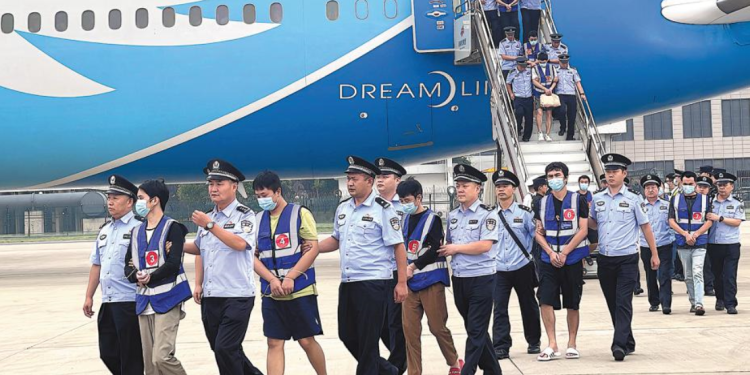
Against the backdrop of Burma’s civil war, cyber scam centers have expanded across the country, becoming a major source of revenue for criminal networks and armed groups. These operations often occupy former casinos and hotels built by Chinese investors prior to the pandemic. When COVID-19 shut down cross-border travel and gambling, criminal groups shifted their focus to online fraud, repurposing the facilities as scam compounds. Many workers are lured by fake job offers and trafficked into Burma, where they are held in brutal, prison-like conditions and forced, under threat of violence, to carry out online fraud. Using scripts and fake profiles, they build trust with victims over weeks or months before duping them. These operations, known as “pig butchering,” rely on romance and investment scams to target victims globally. Last year, the United Nations estimates that at least 120,000 people were working in such centers in Burma. In 2023 alone, these scams stole an estimated $64 billion worldwide, including more than $5.5 billion from U.S. victims. Chinese crime syndicates, often backed by junta officials and local militias, have expanded their operations across Burma’s border regions with China, India, Laos, and Thailand. These areas, largely controlled by ethnic armed groups seeking autonomy, have become havens for criminal activity. In northern Shan State and Laos’s Bokeo Province, lawless zones like Laukkai and Mong La have been transformed into city-sized scam compounds. Unregistered casinos, scam centers, and other illegal businesses now operate freely across this shared criminal zone, beyond the effective control of any country’s government.
One example is the Shwe Kokko Project, a China-backed development zone in Karen State near the Thai border, originally promoted as a new city with casinos and real estate. It is now widely recognized as a hub for online scams, gambling, and human trafficking. The project is a joint venture between the Border Guard Force, now rebranded as the Karen National Army (KNA), and Yatai International, owned by Chinese-Cambodian national She Zhijiang, who is wanted by Beijing. Read more at: https://eng.mizzima.com/2025/07/14/24389